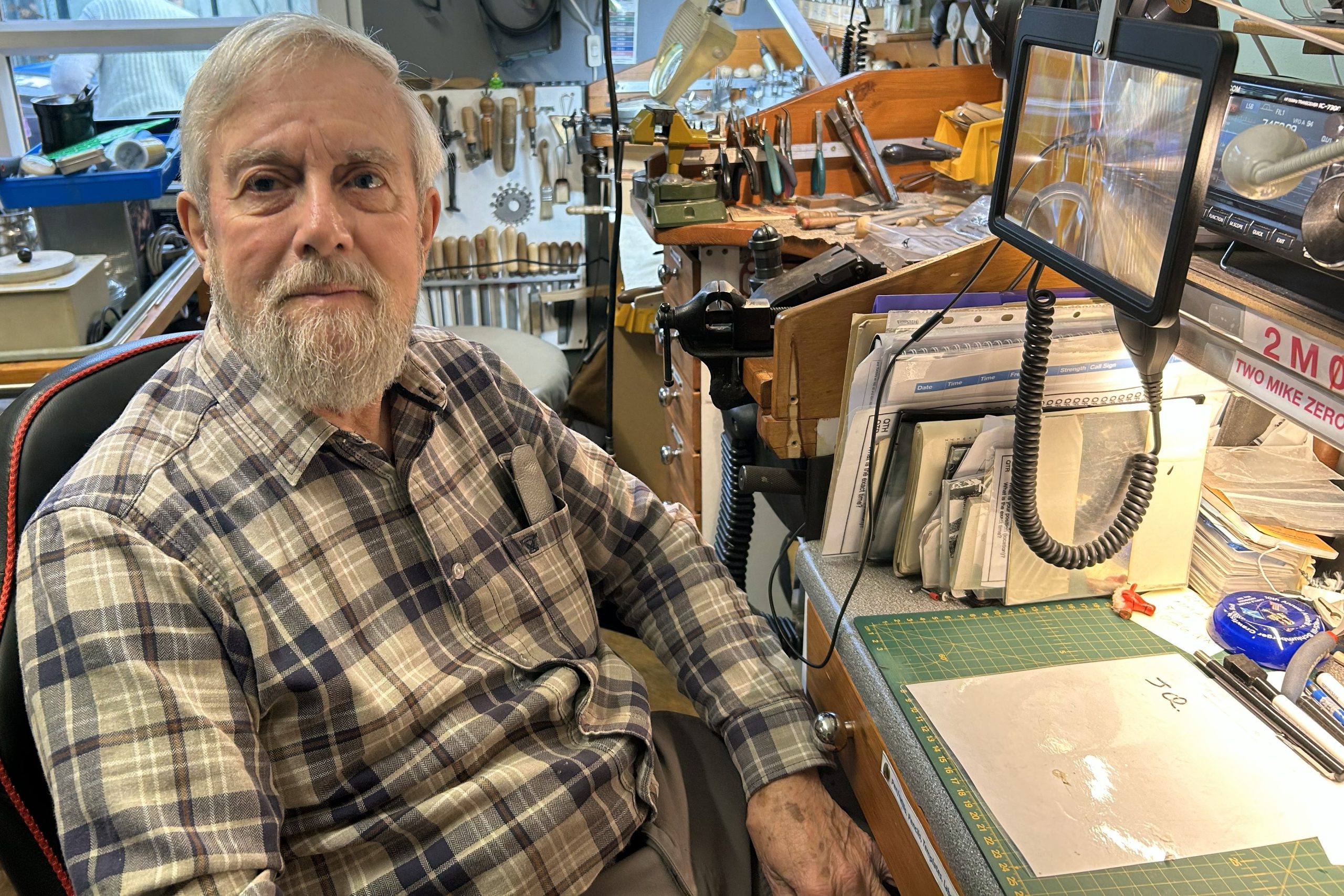
Being diagnosed with Macular Degeneration was a huge shock for Robin, who is a professional jeweller, keen bird watcher and amateur radio enthusiast.
Robin Key, 81, was diagnosed with wet Macular Degeneration in 2019. Macular Degeneration is the most common cause of registerable sight loss in the UK, and involves a loss of central vision, caused by damage to the cone cells in the macula, a tiny area at the back of the retina. With wet macular degeneration, the blood vessels in the back of the eye swell and bleed, causing vision loss. Wet macular degeneration can be managed by injections which slow the deterioration down.
The Macular Degeneration was identified in Robin’s right eye when he was being assessed for the removal of cataracts. Robin says, “I initially was told I had a cataract which needed to be removed. My right eye suddenly started to become a bit affected, but I assumed it was the cataract. When I was told it was macular degeneration, I was referred to the Eye Clinic at Ninewells Hospital in Dundee. I’d heard of Macular Degeneration but didn’t really know what it was. About 3-4 weeks later, I started to notice that there were kinks in the trees, that they weren’t straight. And then the sight went altogether in the right eye, and it was too late for any treatment for the wet macular degeneration. Because it only affected one eye, I was still able to drive and to get about.
A few years later in 2023, I went for a routine eye check and the optician noticed something on my left eye, which then seemed to disappear. A few weeks later, I noticed my sight had become a bit foggy, and with more knowledge about Macular Degeneration, I went back to the optician. He called me right back, did another scan, and sent all of my scans to the consultant at the Eye Clinic. By mid-afternoon, I’d had a phone call from the local Eye Clinic to be there at 9.30am the following morning. For the last two years, I’ve been getting injections in my left eye every two months, which is slowing down the deterioration of that eye. It’s the middle of my eyes that are damaged so I can still see a little bit out of the side of my eye.”
Robin continues, “Getting the diagnosis was an absolute disaster to me, because I use my eyes so much, for work and hobbies. All of a sudden, I was having restrictions imposed on all of those things and I was having to change things quite a lot because of it. Even basic things like watching the television, was becoming a chore rather than an enjoyment. It can be a very lonely place, losing your sight.”
Robin started work as a Merchant Navy radio officer, before working on shore, and in the oil industry. He fell in to jewellery making, when he applied for a jewellery making course which was the only course available at Robert Gordon’s University, and Robin attended Gray’s School of Art, starting a 30-year career in jewellery making, which continues today.
Robin first got in touch with NESS in 2023, who were able to support Robin to resolve a number of difficulties he was experiencing because of his sight loss. NESS’s local Vision Rehabilitation Specialist visited him at home, told him about other NESS services, and made a number of recommendations, including changing the light bulbs to stronger ones and introducing him to a symbol cane. Robin continues, “The symbol cane folds up, and you can easily keep it in your pocket. When I’m walking through busy streets, I take this out and people will move to the side and bump into me a lot less.” Robin also got support from NESS’s ICT officers. Robin was able to use a computer, and had recently upgraded to an Apple Mac which someone had told him had better built-in accessibility features. NESS’s ICT officer was able to help Robin learn to use the Apple Mac, which was different from what he was used to. As well as the computer, Robin uses a smart phone. Robin continues, “I use dictation for using the phone and it reads my messages to me. I tell my phone to “phone home”, for example. It also connects directly to my hearing aids. You need organisations like NESS, or you need to go to a meeting where this information is passed on, and somebody can show you how to use these functions and apps on your phone. I feel really strongly that we should all be telling other people about the tools that we’ve learned about and that help us to manage our sight loss.”
As a keen birdwatcher since childhood, Robin found he could no longer identify birds. Robin continues, “The ICT officer from NESS mentioned something about listening to birds, and so I looked into that and bought myself a microphone and a good recorder so I could record the birdsong. I’ve also got the Merlin app, which picks up birdsong and tells me exactly what the bird is, which also helps me locate it. The Eye Clinic gave me a monocular telescope, a small portable telescope, which helps with the birdwatching. It also helps with reading bus time tables.
“I’ve also got two hand held magnifiers that I got from the Eye Clinic. One is slightly bigger so slightly less powerful – I use this one day to day to read things. The smaller magnifier is slightly more powerful, and I use it for more detailed work. Some of the magnifiers also have LED lights on them which gives better lighting, and I use a magnifier with a light for my jewellery making or repairs, or when I’m teaching traditional jewellery making techniques. I’ve also got special very powerful magnifying glasses, called an optivisor, to help with the jewellery making. “I’ve found different ways for making jewellery and make it by proxy by teaching other people – this helps to keep me involved in the aspects of jewellery making that have become really difficult. I can also make a wax mould for a piece of jewellery, and I send that away for the jewellery to be cast. Once it comes back fully cast, I can polish it and add gemstones. These are quite tactile stages so are easier to do – or I get my students to do it for me.”
During his career as a jeweller, Robin was proud to discover that some of his ancestors were well-known Scottish jewellers, two of whom made jewellery for Queen Victoria and whose work is on display in Perth and in the National Museum in Edinburgh. “I don’t pretend to be anything up to that standard,” he says, “but I feel it is a target to aim to”.
Robin describes the Seeing AI app as an “absolutely amazing piece of technology” that Robin has found really useful. He explains further, “You can use it for all sorts of things. It’ll tell you what money you have in your hands, it can describe a room or a street or anything to you. It can describe a person. If you show it a face and put a name to the person, then when you go into a room it will tell you if that particular person is in the room. I even used it to help me study for exams. Every few months, a new development comes along, but it’s a free app, available worldwide and in multiple languages.
Robin is also a keen user of amateur radio which is a bit like CB radio, except it’s got much more power to go longer distances.
There is a lot of technical knowledge needed to use the amateur radio network safely, and users have to pass an Ofcom exam to have a licence to use it. Robin says, “The Radio Society of Great Britain are very supportive when you take the Ofcom examinations. . They will have people reading the questions to you and writing down your answers and they will give you a longer time to complete the exams.” Robin has set up a couple of magnifiers on stands to help him use his radio.
“Amateur radio is a great hobby because there are no boundaries worldwide to radio, you chat to people all over the world. It’s a connection with other people including visually impaired groups. It’s a big part of my life now.”
Robin continues, “I would really like to thank NESS, the Eye Clinic and Eye Clinic Liaison Officer and most of all my wife for all the support they’ve given me. It really was a big shock when I lost my sight. I feel very strongly that I want to share my experiences with others as they might pick up something that they find helpful. We need to share what we learn with other people”.
Robin’s personal experiences of sight loss show how getting information and support from different places give you access the equipment and technology that is available, and introduce different ways of doing things, that can provide workarounds to hobbies and activities that have become difficult when you have a visual impairment. Getting the information, advice and support at the right time is vital to being able to helping people have the confidence to make the adjustments to overcome the barriers created by sight loss.