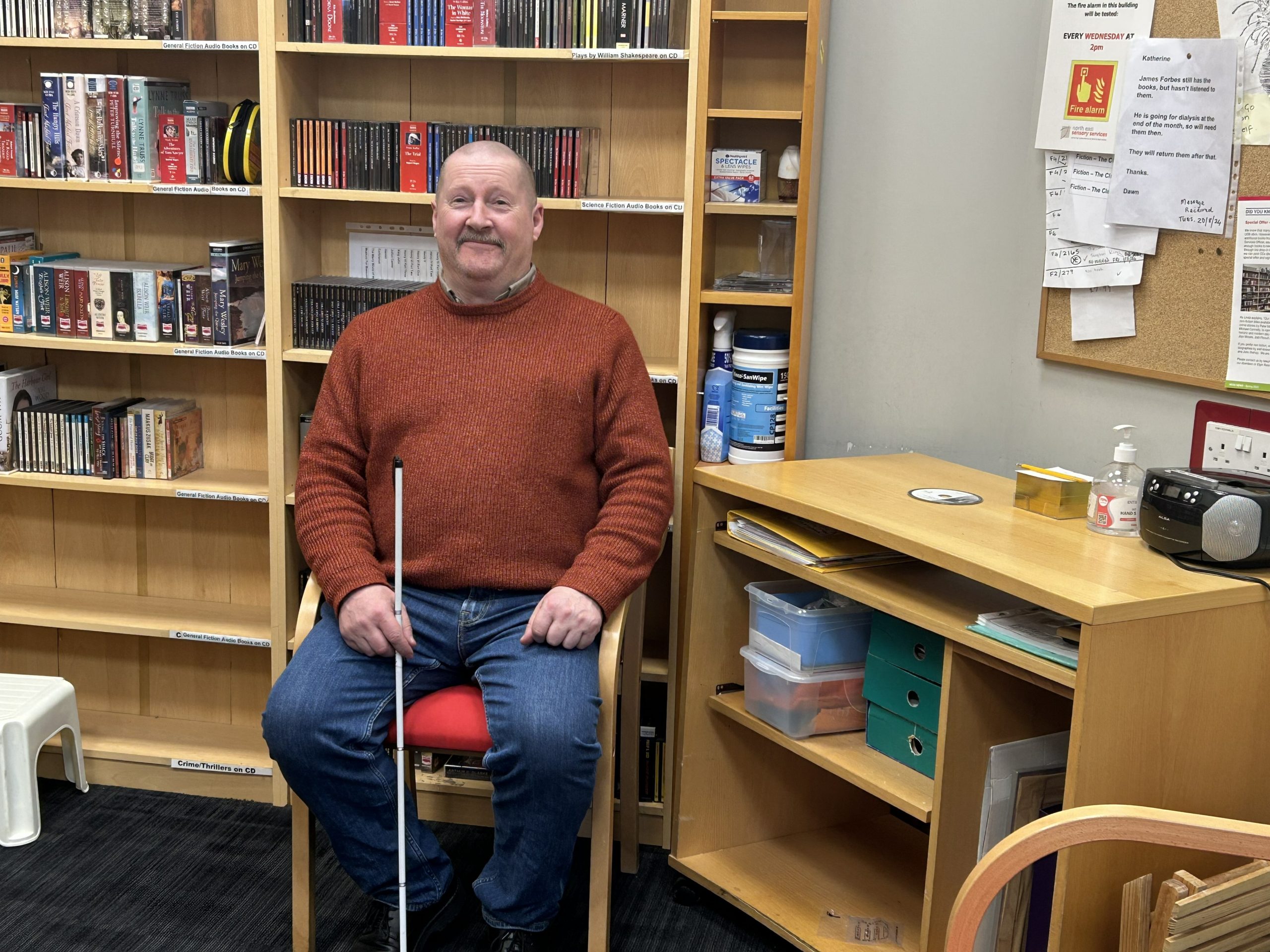
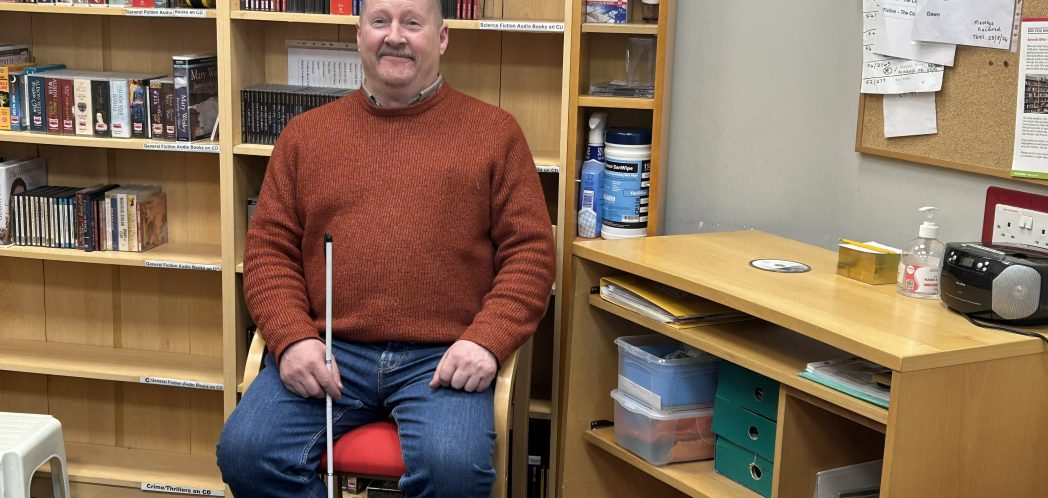
Kevin Shaw, who is now in his 60s, shares his experiences of living with retinitis pigmentosa (RP) and how he came to terms with his sight loss with NESS’s support.
Kevin first noticed there was something wrong with his vision over 20 years ago in his forties when travelling in a car. He describes, “I’m looking out the windows, and the windows are awful steamed up or needing cleaned. I never thought anything about it because my mother and father both wore glasses for reading. And gradually, I started walking into things, then seeing them once I’d walked into them.”
Kevin eventually went to his GP, who referred him to Specsavers. After getting various sight tests at Specsavers, Kevin was diagnosed with cataracts and referred to the specialist at the Eye Clinic at Aberdeen Royal Infirmary as they had also found something else.
After further eye tests at the Eye Clinic, they confirmed that Kevin had Retinitis Pigmentosa (RP), a genetic condition that causes reduced peripheral vision often referred to as tunnel vision.
Kevin continued to work despite the diagnosis for 12 years. He says, “People wouldn’t know I had a problem because I knew where everything was.”
“Although I was comfortable in my work environment, and wasn’t fazed by work, other people at work were noticing things, and would say things like “Watch where you’re going! Or “you just bumped into that thing again!” or “Haven’t you had your eyes tested?”
Kevin continues, “I would say, “Yes, I have and you know I’ve got a problem”. They were trying to be helpful but didn’t know the right words to say.”
Kevin continues, “Some days are better than others. My sight can change with the weather. On a winter’s morning when it’s pitch-black outside, I could walk into a dustbin, because I can’t see it.
When I was working, I knew the bus I had to take, I knew the route, I knew where I was going. But if there was a van unloading on the pavement, I would walk right into it and only see it if after.”
When the plumbing business closed in 2017, Kevin was made redundant. After a couple of weeks looking for jobs, and a visit to the JobCentre he was offered work working for the City Council at their stores. Kevin found that in a different environment, he couldn’t see. He says, “Because everything was so different, I walked right into things, I almost walked into a van. I realised that I was a risk to myself and other people and decided I couldn’t do this type of work anymore and I left. I really didn’t want to involve anyone in anything; it was my sight that was the problem. It’s a blessing in disguise that the earlier workplace closed.”
Kevin first contacted NESS when he was made redundant, when a member of staff at the job centre signposted him to NESS. Kevin describes visiting the JobCentre Plus after he was made redundant as terrifying, partly because he couldn’t see clearly where he was going and partly because of the lack of awareness of most of the staff there. Kevin explains, “Staff just shouted out my name, but I couldn’t see who had shouted my name. I had my symbol cane with me, but people still didn’t come over to me to call my name.
Up until that point, Kevin had been managing at home and at work, even though his sight was slowly deteriorating. Kevin says, “I was in denial. I didn’t want to think about what was going to happen eventually.
Kevin continues, “The people [at NESS} have been great, really helpful, really supportive.”
Kevin had to go back to the Eye Clinic and was put in touch with the Hospital Information Officer there, who was able to guide him through the process of being registered severely sight impaired. About a year or so later, Kevin was put in touch with the Vision Rehabilitation Specialist (or Rehab Worker), who introduced him for the first time to a cane.
Kevin continues, “To start with, I was saying “No, I’m not ready for this”, but slowly, surely, she encouraged me, supported me, and reassured me that people would move out of my way, and most of them do. Occasionally you get the odd one who doesn’t. Now, I wouldn’t be without the cane. It’s made a big difference, given me a lot of confidence. I go out to the see lots of theatre shows with a friend. The reception staff told me about the Access Card, which allows you to bring a companion with you for support for free”.
He says, “I like to be 2-3 rows from the front at the end of an aisle so that I’m not annoying people when it’s time to come in and out.”
Recalling a conversation he had with the Hospital Information Officer, Kevin explains how he manages to get out and about. He says, “I mentally prepare my journey, and I avoid crowded places unless someone’s with me. I plan the route I’m taking, the bus I’m getting, the shops I’m going to and the route back home again.”
Kevin continues, “One time I walked into a lamppost. Usually, I go to the crossing and wait for the green man to cross the road. One time, there was no traffic coming, and the traffic lights were a good bit down the street so I thought I would cross where I was, and I walked straight into a lamppost – boom! Thankfully, it wasn’t a cement lamppost, but I had a big black eye. At the time, I thought I was perfect, sorted, that there was nothing wrong with me anymore. That incident was a wakeup call. I was getting over confident.”
Kevin continues to visit NESS regularly, to get support to handle correspondence. Kevin says, “If I get letters that I don’t understand, I take it to see the duty staff at 2pm and they help me. A lot of letters want you to go online but I can’t go online. I’ve tried learning but I can’t see the cursor or work the mouse.”
Kevin describes the frustration he feels when he is signposted to go online to deal with correspondence. “Letters are often in small print, but a lot of the time, they don’t make sense. They will tell me to go online, that it’s much easier, but I can’t, so I phone, but that often doesn’t work.
“When I get formal letters e.g. about benefits, I can feel the pressure because I don’t understand the system.”
Kevin decided to show his appreciation of the support he gets from NESS. He organised a “Guess how much is in the jar competition,” with a prize fund and the rest and ticket sales going to NESS. It was so successful, that Kevin is doing this again, but is saving 10ps, 20ps, and 50ps.
Kevin reflects on how his RP has changed over time. “When I was first diagnosed with RP, it was just a bit of fuzziness, a bit of a blur. It’s different in different people. For some people like me, it gradually deteriorates. I know my sight is worse than what it was 2-3 years ago.
When I was first diagnosed, I struggled with the idea that I was a burden to others. I would worry that when I was invited out, I would just get in people’s way, and I didn’t want to be a burden. People would try and reassure me and say, “You’re not a burden, we wouldn’t have invited you if we thought you were a burden.”
“Now, I understand that I can’t change this, this is the cards I’ve been dealt. Gaining more confidence with the support from NESS has helped me to understand this, given me the confidence to soldier on. I’ve tried to take on everything that people have told me, to read the information I’ve been given, and all of that has given me confidence.”
Over the years, Kevin has taken part in a number of training courses, including cookery, Food Hygiene, and computing and was asked to talk to council staff about his experiences of sight loss, with the support of our Employment Officer, all of which he’s really enjoyed apart from the computing skills.
Kevin explains how difficult it can be to access services as someone who is visually impaired, especially when staff lack awareness of the barriers that people with sight loss experience.
He explains, “When you walk into somewhere, someone will say, “How can I help you? ” And you explain you’ve got to see someone on the first floor, so the person says something like, “oh, the lift is over there”. I can’t see over there. So, you arrive at the door to the first floor, but you’re not sure if you should go through. When you do go through the door, you are in a big reception area, and someone will say “just have a seat,” but I can’t see where the seats are. Then, someone will shout my name, but I can’t see who it is, and they start to get impatient. I’ve got my white cane with me, so it’s clear I have a visual impairment, but I don’t think they’ve had training. They should be able to approach someone to call them to their appointment.
“All people have to do,” continues Kevin, is show me where to take a seat so I’m facing the person that I am due to see, so they don’t need to shout my name. Kevin continues, “Don’t approach me from behind, or the side, I can’t see anything to my side. I can only see things that are right in front of me”.
With NESS’s support, Kevin has felt more able to deal with interactions like these. Kevin says, “I’m quite a strong-willed person, but these kinds of interactions do knock me.”
Kevin has been able to adapt to life with RP using all of the information and support that was available to him, and engaging in all of the opportunities offered to him to meet new people and build his confidence.
Thank you Kevin for sharing your experiences, and for your generous fundraising for NESS – we really appreciate both.